
Managed IT services can sometimes fall into ‘one of those things’ that an SME has, or needs, without directors always stopping to consider the value their provider is actually delivering.
Technology underpins much of our operations across all sectors from manufacturing to professional services to not-for-profit. The familiar refrain of ‘our wifi is down again’ might just become part of the daily working life for a lot of businesses. So much so that they don’t sit down to investigate why this is and what to do about it.
That’s why we sat down with our Managing Director, Sandy Gaggini, to get her thoughts on what you should expect from a managed service provider.
This article contains:
- What are managed IT services
- The difference between managed IT services and traditional IT support
- Do managed IT services replace an in-house IT team
- What a MSP should deliver
- Are you getting what you should from your current IT provider?
- Where businesses can get independent IT and cybersecurity advice
- More about EBS and how we can help
Firstly, what are managed IT services?
Managed IT, managed IT services, managed service provider (MSP), managed IT provider all refer to the same operating model when it comes to information technology. They all describe an ongoing service where a business appoints an IT provider to manage their technology.
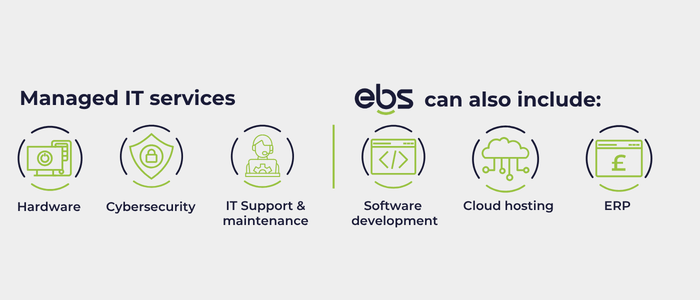
This is likely to include a range of different technology services including:
-
- Hardware. Day-to-day infrastructure your business needs to operate including laptops and workstations, servers, network communications and more
-
- Cybersecurity. Helping keep your business protected against cyber threats.
-
- IT support and maintenance. Keeping systems running, resolving issues and proactively monitoring your technology.
And for some MSPs, such as ourselves, it might also include:
-
- Software development for bespoke windows and web applications
-
- Cloud hosting for connectivity off-site as well as on-site
-
- ERP (Enterprise Resource Planning) such as Sage 50 or Sage 200 that connects your financials to your operations.
As a service, your MSP should tailor to your business. They might provide some, or all, of the above to help keep your business operational.
What’s the difference between managed IT services and traditional IT support?
When EBS first started operating in 1979, the technology landscape looked very different. As a business, we’ve seen many changes in the technology we supply as well as how we supply it.
Managed IT services allow for a proactive approach to technology. Rather than a traditional IT support approach of ringing when something is broken, an MSP should be working in the background to maintain and monitor your systems, identify potential issues and look for areas where technology could improve the way your business works.
We asked Sandy, our Managing Director, for her thoughts on this, and she said “Our approach is focused on collaboration and partnership with our clients.

We create a relationship with our clients where we understand their business, not just their technology. Rather than someone they call when something breaks, we are there for the day-to-day decisions and developments and feel like an extension of their team. It’s why we have customers whom we have worked with for decades.
Sandy Gaggini
Do managed IT services replace an in-house IT team?
Not necessarily. Your optimal MSP solution can depend on business size or need. While there is no hard or fast rule of thumb, the following might be a useful guide when thinking about IT support:
Fully out-sourced
Depending on the size or nature of your business, a full-time employee dedicated solely to IT might be cost-prohibitive. This is where outsourcing fully to an MSP can give you cost-effective technology support.
Hybrid solution
A bigger business might have employees solely or partially responsible for all, or some, IT functions.
Co-managed
Your business is large enough for an in-house team but needs additional expertise from a managed service provider for some areas such as cybersecurity.
A good MSP should work with you to identify the optimum service for your business alongside any in-house expertise and resources that you have.
What should a managed services provider deliver?
A managed service provider should deliver a range of IT solutions that your business needs. This might include:
- Cybersecurity, including antivirus, firewalls, web and email security
- Cloud hosting and computing
- IT consultancy and strategy
- Infrastructure and network management
- Connectivity
- Hardware
- Additional services such as email signature management
The IT solutions are only part of what you should expect. A good MSP should help prevent IT problems arising and ensure your technology runs smoothly and reduce disruption. They should be monitoring and maintaining your technology, raising issues with you when something needs attention and helping you plan for what your business will need next.
You should have a dedicated Account Manager who meets with you regularly and helps develop an IT strategy for your business. Contact with the directors of your MSP should also be in the mix alongside clear processes and SLAs so that you know what to expect from them.
Sandy says:
The services are just as, if not even more so, important than the solutions offered. You want your customers to know that you are there to add value as well as in an emergency.
Measuring our customer satisfaction is crucial. We use that feedback to enhance our customer service as well as introduce new IT features. A good MSP should always be open to a conversation with a customer.
That’s why, as Managing Director, I know our clients and they know they can always reach out to me. They have an Account Manager but they also know our teams and directors so that they can get the best from a partnership with EBS.
Sandy Gaggini
Are you getting what you should from your current IT provider?
Reviewing your service and solutions from your current IT provider should be similar to evaluating any other supplier. However, when it comes to such a technical area it can be useful to gain third-party advice on what to look for. The National Cyber Security Centre have put together guidance on choosing a managed service provider (MSP) that highlights:
- Reviewing certificates and their partners
- Checking testimonials and case studies
- Understanding response and resolution times
- Regular reviews, reports and audits
- Monitoring and incident notification
- Access and security control
- Contract duration and exit clauses
Their detailed guide includes a checklist of questions that you can ask your existing MSP or when choosing a new provider. And one crucial thing to consider is that they should never hit you with an unexpected invoice. Invoicing, alongside the rest of their service, should be clear and transparent.
Sandy says
We always want to be transparent with our customers but also with anyone who talks to us. Our case studies and testimonials are across our website alongside our suppliers and certifications.
It is important for us to put our live data - such as our customer satisfaction score - on the homepage of our website for anyone to see.
Sandy Gaggini
Where can businesses get independent IT and cybersecurity advice?
If you’re reviewing an existing managed services provider, or considering a new MSP, there are a range of places you can go to for advice on specialist IT topics or to qualify their business approach including your local chamber of commerce or your regional cyber resilience centre.
It is important to us to work within the Midlands and wider UK. It is why we are a community member of the West Midlands Cyber Resilience Centre and Greater Birmingham Chamber of Commerce too.
They both allow businesses to understand that we are experts in our field and committed to SMEs across our region.
Sandy Gaggini
Find out more about EBS and how we can help
Our team is always available through LiveChat on our website or email hello@ebs.tech or call us on 0121 384 2513. You can also: