Executive Summary
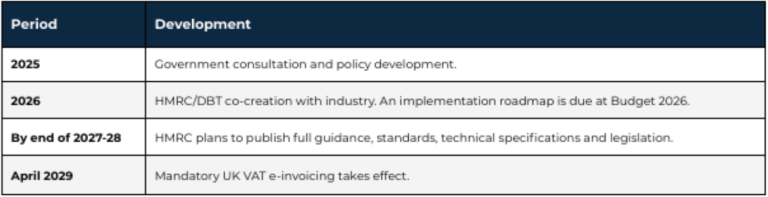
From April 2029, the UK Government will require VAT invoices to be issued in a specified electronic format. HMRC’s 2026 Transformation Roadmap describes mandatory e-invoicing for business-to-business (B2B) and business-to-government (B2G) transactions and says full guidance, standards, technical specifications and legislation are planned by the end of 2027-28.
The largest operational change will be that invoice information needs to exist in a standardised, machine readable form. Businesses will therefore need accounting software, ERP software or an integrated e invoicing service capable of creating and receiving compliant invoices. For businesses, this represents a move away from invoice processes based primarily on PDFs and email towards structured invoice data that can pass directly between finance, ERP, accounting and accounts payable systems.
What is an E-Invoice?
An e-invoice is a structured electronic invoice that can be created, transmitted, received and processed electronically by business systems. It is fundamentally different from simply creating a PDF invoice and attaching it to an email.

Confirmed UK timetable
What changes for businesses?
The largest operational change will be that invoice information needs to exist in a standardised, machine readable form. Businesses will therefore need their accounting software, ERP platform, finance system or an integrated e-invoicing service to be capable of creating and receiving compliant invoices.
Sales invoices: invoices should increasingly flow directly from the supplier’s finance system to the customer’s system rather than relying on emailed PDF documents.
Purchase invoices: structured supplier invoices can potentially enter accounts payable workflows automatically, reducing re-keying, OCR and manual invoice handling.
Controls: organisations will need robust handling of VAT data, customer and supplier identifiers, credit notes, validation errors, rejected invoices, attachments, audit trails and archiving.
Why the Government is introducing it
HMRC identifies e-invoicing as part of the wider modernisation of the tax system. Expected benefits include greater automation, reduce administrative effort, fewer errors, improved productivity and potential improvements in cash flow and late-payment performance.
E-invoicing and Making Tax Digital
Making Tax Digital (MTD) primarily digitises accounting records and tax reporting. E-invoicing digitises the commercial invoice exchanged between supplier and customer. The two initiatives are complementary but are not the same thing.
Implications for ERP and accounting systems
The key question for every organisation is not simply whether its current software can create and email a PDF. The strategic question is how its finance platform will create, send, receive and process invoices in the electronic format and infrastructure ultimately specified by the UK Government.
Depending on the software and vendor roadmap, capability may be delivered natively, through an ERP/accounting software update, or through an integrated specialist e-invoicing provider. Businesses should consider both outbound sales invoicing and inbound purchase invoice automation.
Questions businesses should start asking
- What is our software vendor’s UK roadmap for mandatory e-invoicing?
- Will capability be native to our existing platform or require a third-party integration?
- How will sales invoices and credit notes be created, validated and transmitted?
- How will incoming purchase invoices enter our finance and approval workflows?
- What customer and supplier master-data changes will be required?
- How will validation failures, rejected invoices and audit trails be managed?
- How will existing document management, AP automation, EDI and integration solutions interact with e-invoicing?
- What testing will be required with customers, suppliers and other trading partners?
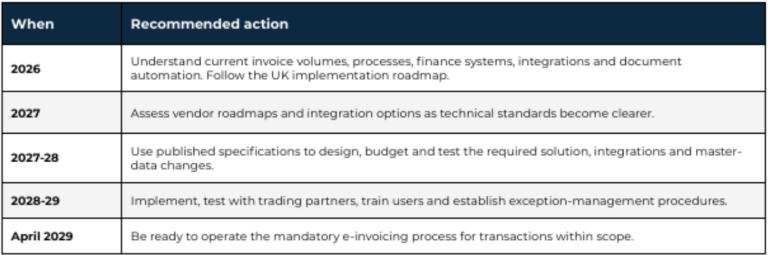
Recommended preparation: 2026-2029
Key takeaway: e-invoicing is an organisation-wide finance, systems, integration and trading-partner project rather than a simple change to invoice stationery. Businesses should avoid assuming that their existing ERP or accounting package will automatically make them compliant without reviewing the vendor roadmap and their own processes.
Sources
HM Treasury, Budget 2025: requirement for VAT invoices to be issued in a specified electronic format from April 2029; implementation roadmap planned for Budget 2026.
HM Revenue & Customs, Transformation Roadmap – Progress Update 2026 and annex: mandatory e-invoicing, industry co-creation, roadmap and planned publication of guidance, standards, technical specifications and legislation by the end of 2027-28.
Prepared September 2026. General business information only; not tax or legal advice.